Water Heater Costs — Complete Guide
Water heater costs confuse more homeowners than almost any other home expense, because most companies hide their prices behind a "call for a quote" button. This water heater cost guide takes the opposite approach and puts real number ranges up front for repair, replacement, installation, and day-to-day operation. You'll learn what Reno homeowners typically pay, which factors move the price up or down, and how to spot hidden fees before you sign anything. By the end, you'll know how much a water heater should cost, so no one can surprise you at the invoice.
What You'll Find in This Guide
Coming soon — we're building out this topic cluster.
What Drives the Cost of Water Heater Replacement and Installation in Reno
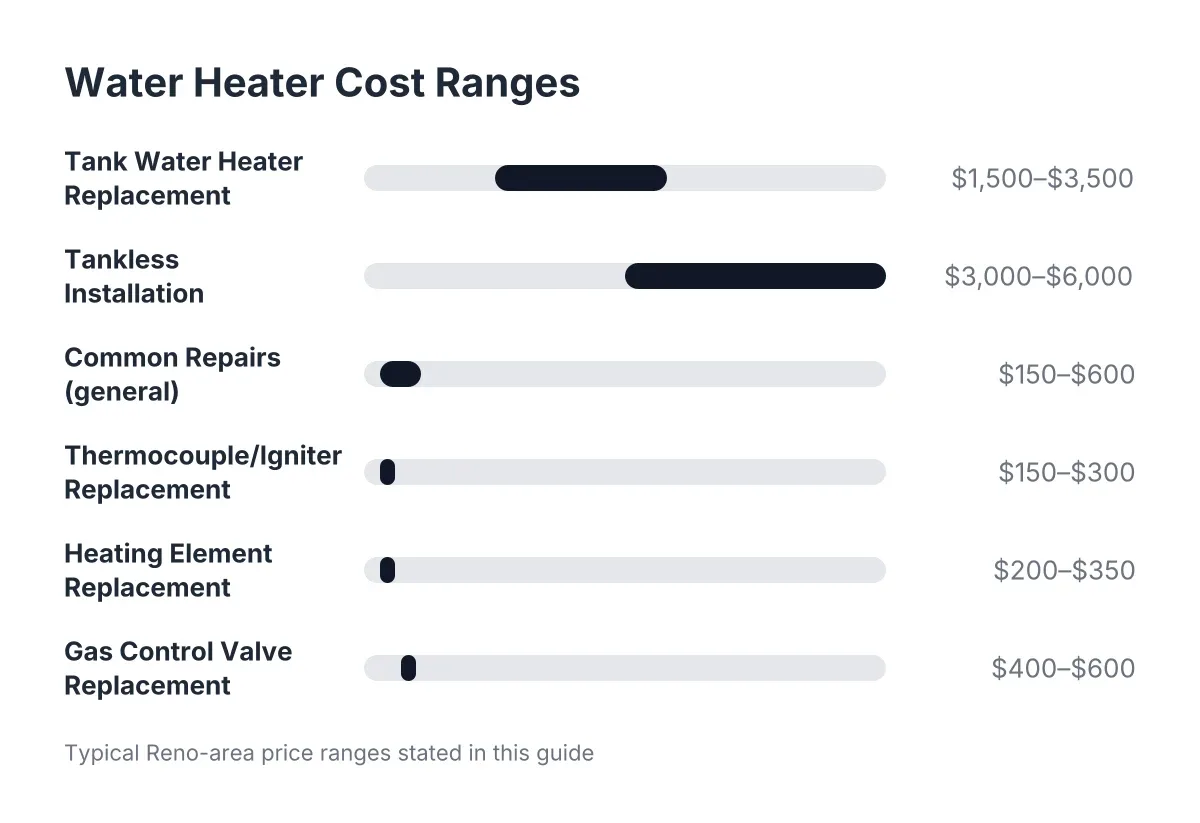
Replacement is the biggest single expense in the water heater world, so let's start there. For a standard tank water heater, most Reno homeowners should expect a total installed price somewhere between $1,500 and $3,500. That range covers the unit itself, labor, haul-away of the old tank, and code-required parts. Tankless installations run higher, typically $3,000 to $6,000 or more, because they often need gas line upgrades, new venting, or electrical work.
Why such a wide range? Several factors move the number. Tank size matters, since a 50-gallon unit costs more than a 40-gallon one. Fuel type matters too, because gas and electric units carry different equipment and labor requirements. Location inside your home plays a role as well. For example, a water heater tucked in a tight closet or attic takes longer to swap than one in an open garage, and labor time drives price.
Where the Money Actually Goes
To put it simply, a fair replacement quote breaks into three buckets: the unit, the labor, and the code compliance items. The unit usually accounts for 40% to 60% of the total. Labor covers removal, installation, and testing. Code items include things like expansion tanks, seismic straps, drip pans, and updated venting. These parts are not upsells. Nevada code requires most of them, and a contractor who skips them leaves you with an installation that may fail inspection or void your warranty.
That said, this is exactly where hidden fees creep in on low-ball quotes. A company advertises a $999 install, then adds the expansion tank, the permit, the haul-away, and the "difficult access" charge on site. Suddenly you're at $2,400 with the old tank already disconnected. With this in mind, always ask for a written, all-in price before work begins. A trustworthy quote lists every line item and states clearly that the number will not change unless you approve a change first.
Beyond that, remember what the alternative to replacement can cost. According to Alpine Intel, IBHS estimates water heater failure insurance claims average $4,444 per claim. As a result, replacing an aging tank on your schedule almost always beats replacing it after it floods your garage.
Water Heater Repair Costs: What's Fair and What's Not
Not every problem requires a new unit, and repair is often the smarter first move. However, repair pricing varies wildly between companies, so this guide needs a baseline for typical repair expenses too. In practice, most common water heater repairs in the Reno area land between $150 and $600. Simple fixes sit at the low end, while bigger component swaps sit at the high end.
Here is a realistic picture of typical repair categories. Thermocouple or igniter replacement usually runs $150 to $300. Heating element replacement on electric units typically costs $200 to $350. Thermostat replacement lands in a similar range. Gas control valve replacement is one of the pricier repairs, often $400 to $600, because the part itself is expensive. Pressure relief valve replacement generally costs $150 to $300. If a company quotes far above these ranges without explaining why, ask questions or get a second opinion.
When Repair Stops Making Sense
The harder question is whether to repair at all. A useful rule: if your water heater is past eight to ten years old and the repair costs more than a third of replacement, put the money toward a new unit instead. For example, spending $550 on a gas valve for a twelve-year-old tank rarely pays off, because the tank itself is near the end of its life.
Leaks change the math entirely. IBHS data shows 69% of all water heater failures result from a slow leak or sudden burst, according to Alpine Intel. This means a leaking tank is not a repair candidate. Once the tank itself corrodes through, no part swap fixes it, and every day you wait raises the risk of water damage. In contrast, a leak at a fitting or valve is usually a quick, inexpensive fix.
Emergency repair carries a premium, and that's normal. After-hours or weekend calls often add $100 to $300 to the standard rate. That said, the premium should be stated up front, not discovered on the invoice. A straight-talk company tells you the emergency rate on the phone before the truck rolls.
Ongoing Water Heater Costs: Gas vs Electric and the Price of Neglect
Purchase price is only half the story. Your water heater runs every day for a decade or more, so operating cost deserves a spot in your math. Generally speaking, gas water heaters cost less to run per month in most markets, because natural gas is cheaper per unit of heat than electricity. Electric units cost less to buy and install, but they usually cost more each month. Over ten years, the operating difference can add up to more than the price gap at purchase.
Tankless units shift the equation further. For homes using 41 gallons or less of hot water daily, the Department of Energy reports tankless water heaters can be 24% to 34% more energy efficient than conventional storage tanks, per Bradford White Water Heaters. However, tankless still makes up a small slice of American homes. Roughly 97% of U.S. residential water heaters are the traditional storage tank style, according to Alpine Intel's summary of DOE data. In other words, tanks remain the default, and for many households they remain the right value.
The Cheapest Money You'll Spend: Maintenance
Maintenance is the most ignored line in the water heater costs budget, and that's a mistake. An annual flush and inspection typically costs $100 to $200. Compare that against the average failure claim of $4,444 cited earlier, and the return on that small spend is obvious. Yet ConsumerAffairs reports fewer than 20% of homeowners take precautionary steps, such as water heater maintenance, to protect against water damage.
Regular maintenance does three things for your wallet. First, it extends tank life by removing the sediment that eats tanks from the inside. Second, it keeps efficiency up, because a sediment layer forces the burner or element to work harder. Third, it gives a technician a chance to catch a failing valve or a slow leak before it becomes a flooded floor. As a result, a $150 annual visit routinely delays a $2,500 replacement by years. Few home expenses offer a better trade.
How Much Should a Water Heater Cost? A Quick Sanity Check
Pull all of this together and you get a simple framework for judging any quote, and that's really the point of a good water heater cost guide. Standard tank replacement runs $1,500 to $3,500 installed. Tankless installation runs $3,000 to $6,000 or more. Common repairs run $150 to $600. Annual maintenance runs $100 to $200. Emergency premiums add $100 to $300 on top of standard rates. If a quote lands inside these ranges and comes with a written breakdown, you're probably dealing with a fair operator.
However, price alone doesn't tell the whole story. The lowest quote often becomes the highest invoice once the add-ons appear. So judge quotes on completeness, not just the headline number. A complete quote names the exact unit model, includes the permit, lists code-required parts, covers haul-away, and states the labor warranty in writing. Anything vague deserves a follow-up question.
Beyond the quote itself, timing shapes your total water heater costs more than most people realize. A planned replacement lets you compare options, pick the right size, and schedule at a normal rate. An emergency replacement forces a fast decision, often at an after-hours premium, sometimes with water damage stacked on top. For that reason, an aging tank showing rust-colored water, rumbling sounds, or moisture at the base is telling you something. Acting on those signs early is the single biggest cost-control move available to you.
Finally, stay skeptical of any company that refuses to discuss numbers before arriving at your home. Fair market pricing survives daylight. A contractor confident in their rates will talk ranges on the phone, explain what changes the price, and put the final number in writing before touching a wrench.
Ready to Get Started?
If your water heater is acting up, leaking, or simply past its prime, you now know what fair pricing looks like. Call us for straight answers and real numbers before any work begins, with fast local service across Reno when the hot water stops. No mystery quotes, no surprise fees, just a water heater fixed or replaced at a price you understood from the start.