No Hot Water Troubleshooting — Complete Guide
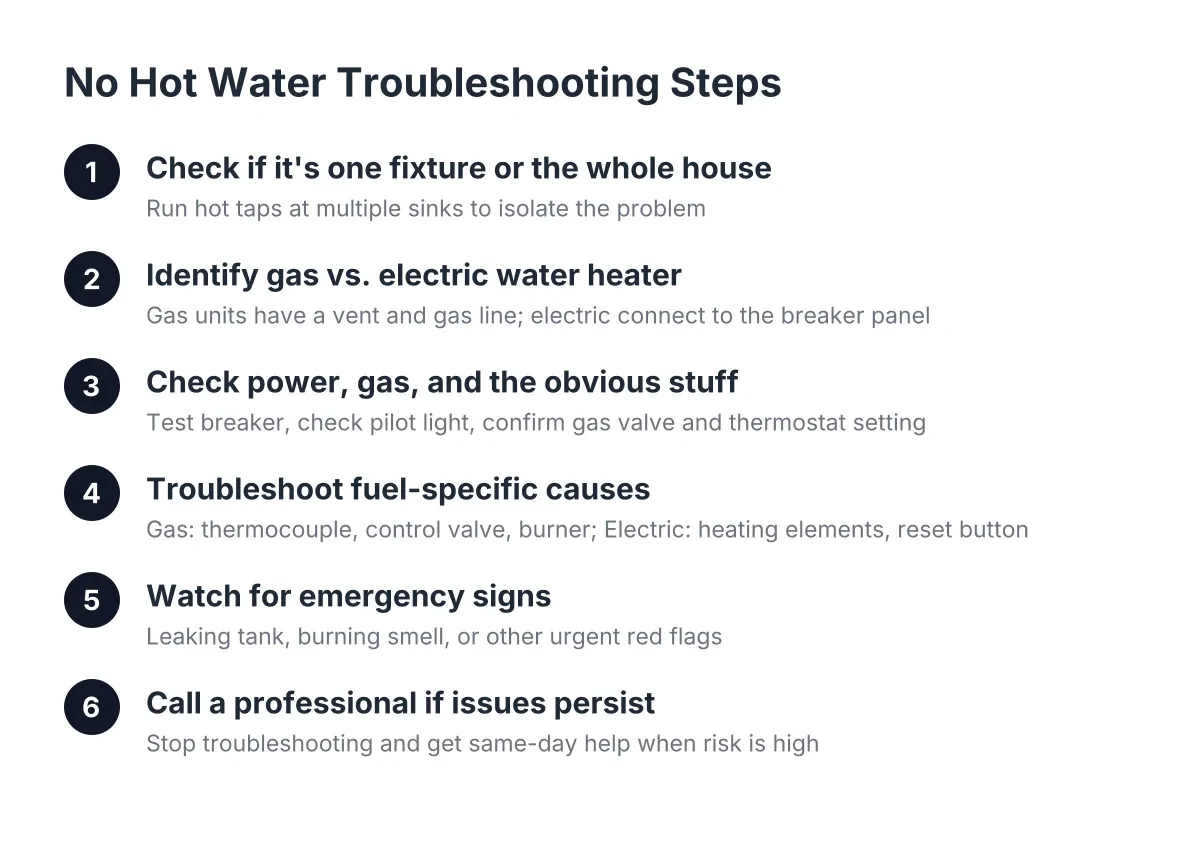
When your shower runs cold at 6am or 2am, you need answers fast, not a plumbing lecture. If you want no hot water quick fixes rather than theory, this guide gives them to you first, then explains the reasoning behind each one. This guide to no hot water troubleshooting walks you through the most common reasons Reno water heaters quit, from tripped breakers and failed pilot lights to burned-out elements and dying tanks. You will learn how to run safe checks yourself, how to tell a gas problem from an electric one, and how to recognize when the situation is a true emergency. By the end, you will know whether you can restore hot water on your own or whether it is time to call for same-day repair.
What You'll Find in This Guide
Fast Checks for No Hot Water You Can Run in Five Minutes
Before you assume the worst, run a few quick checks. In practice, a surprising number of no hot water calls trace back to something simple, and these checks take about five minutes with no tools required.
Start at the water heater itself. Look for water pooling around the base, dripping connections, or rust streaks down the tank. If you see standing water, stop troubleshooting and shut off the water supply to the heater right away. According to Alpine Intel, IBHS data shows 69% of all water heater failures result from a slow leak or sudden burst. That means a leak is not a side issue; it is often the main event, and it can escalate quickly.
If the tank stays dry, check the power or fuel next. For an electric water heater, go to your breaker panel and look for a tripped breaker. Reset it once. If it trips again, leave it off, because a repeatedly tripping breaker usually points to a shorted heating element or wiring fault. For a gas water heater, confirm the gas valve is open and check whether the pilot light is out. Many newer models show a status light that blinks an error code, so note the pattern before you call anyone, since it speeds up diagnosis.
Confirm the Problem Is the Heater, Not the House
Next, figure out how widespread the problem is. Turn on hot taps in two or three rooms. If one faucet runs cold but another runs warm, the issue may sit in a single fixture or mixing valve, not the heater. Additionally, check whether cold water pressure is normal, since low pressure on both hot and cold sides can point to a supply problem rather than a heating problem.
One more clue matters for Reno homeowners in winter. If you have no hot water but the furnace works, you can usually rule out a whole-house gas outage, and that narrows the fault to the water heater itself. At that point, the fix depends on what type of heater you own, which is exactly where the next section picks up. If the quick checks turn up nothing obvious, our no hot water repair service exists for precisely this moment.
Why Gas and Electric Water Heaters Fail to Produce Hot Water
The right troubleshooting path depends entirely on your fuel type. Gas and electric water heaters fail in different ways, and mixing up the two wastes time you do not have. To put it simply, gas heaters usually fail at the flame, and electric heaters usually fail at the elements. Knowing which category applies to your unit is the fastest route to a diagnosis.
Gas Water Heater No Hot Water Troubleshooting
Gas units heat water with a burner at the bottom of the tank, so most gas failures involve ignition. The classic culprit is a pilot light that goes out and refuses to stay lit. Behind that symptom often sits a failed thermocouple, the small safety sensor that shuts off gas when it cannot detect a flame. A dirty burner assembly, a blocked air intake, or a faulty gas control valve can cause the same cold-water result.
You can safely attempt to relight a pilot by following the instructions printed on the tank. However, if it will not stay lit after two attempts, stop, since repeated relighting attempts will not fix a bad thermocouple. Forcing the issue with gas appliances is never worth the risk. If you ever smell gas near the unit, leave the area and call your gas utility before anything else.
Electric Water Heater No Hot Water Troubleshooting
Electric units heat water with two elements, one upper and one lower, each controlled by a thermostat. When an electric water heater produces no hot water at all, the upper element or its thermostat has usually failed. By contrast, lukewarm water that runs out fast often points to a dead lower element, since the tank only heats its top portion.
Beyond the elements, check the high-limit reset button, usually a red button behind the upper access panel. It trips when water overheats, and pressing it once may restore operation. That said, a reset that keeps tripping signals a stuck thermostat or failing element, and that calls for a repair visit. Element and thermostat replacement involves 240-volt power, so leave the actual swap to a licensed pro unless you feel confident cutting power at the breaker and testing with a multimeter. Our Reno no hot water repair team handles both gas and electric diagnostics, usually the same day you call.
When No Hot Water Means Emergency, Repair, or Replacement
Not every cold shower is an emergency. However, some situations demand immediate action, and knowing the difference protects both your home and your budget.
Signs You Should Call an Emergency Plumber Now
Treat these as urgent, regardless of the hour. First, watch for any active leak from the tank body itself, since a leaking tank does not heal and a slow drip can become a burst. Alpine Intel reports that IBHS estimates water heater failure insurance claims cost an average of $4,444 per claim, and most of that cost comes from water damage, not the heater. Second, take a gas smell near the unit seriously. Third, popping or rumbling followed by moisture at the temperature and pressure relief valve can indicate dangerous pressure buildup. In each of these cases, shut off the water supply, kill the power or gas, and call for emergency help rather than waiting for morning.
Repair or Replace: Making the Call Under Pressure
If the situation is safe but the water is still cold, the question becomes repair versus replacement. Age drives the decision more than anything else. Most tank heaters last eight to twelve years, so a failed element in a five-year-old unit is an easy repair, while a leaking tank at year eleven is a replacement conversation. Per the Department of Energy, roughly 97% of U.S. residential water heaters are the traditional storage tank style, according to Alpine Intel, so most Reno homeowners face exactly this tank-age math. If you are replacing anyway, it is worth comparing tank and tankless options for efficiency and sizing.
Finally, do not skip the lesson hidden in the breakdown. Fewer than 20% of homeowners take precautionary steps, such as water heater maintenance, to protect against water damage, according to ConsumerAffairs. In other words, most failures announce themselves early through sediment noise, slow recovery, or minor drips, and most people ignore the warning. A yearly flush and inspection costs far less than an emergency replacement at 2am. If your heater already quit, though, maintenance advice can wait — get the diagnosis first, then decide on repair or replacement with real numbers in hand.
Ready to Get Started?
If you ran the checks above and your water is still cold, you do not need more troubleshooting. You need a local tech at your door with the parts to fix it. Call us for straight-talk pricing and fast, same-day no hot water repair anywhere in Reno.